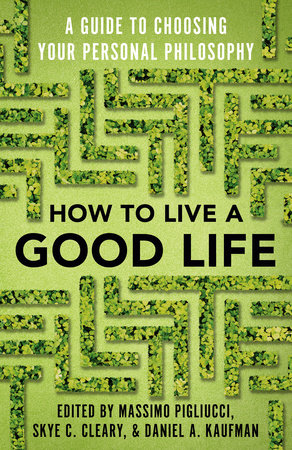
How to Live a Good Life, Edited by Massimo Pigliucci, Skye C. Cleary and Daniel A. Kaufman
Edit picked this up as soon as it came out and I got first go at it. Billed as "A guide to choosing your personal philosophy" it is a collection of essays written by practitioners of a range of practical philosophies and religions. Each philosophy is presented in brief, but through a personal lens. The book is divided into sections on eastern philosophies (Buddhism, Confucianism, Daoism), classical western philosophies (Aristotelianism, Stoicism, Epicureanism), "Religious Traditions" (Hinduism, Judaism, Christianity, Progressive Islam, Ethical Culture), and modern philosophies (Existentialism, Pragmatism, Effective Altruism, Secular Humanism). So it's certainly not exhaustive -- what book could be? -- but its range is broad and diverse.
Given the format, I figured I could probably dive in anywhere, so I went for the modern section, which caught my curiosity. Here, more than the rest of the book, I found the personal stories more interesting than the philosophy. Existentialism and Pragmatism are certainly presented a very personal searches, but Effective Altruism -- as on offshoot of utilitarianism -- seems the application of a formula. I was deeply impressed by the commitment and goals of its practitioners, while the philosophy struck me as somewhat bonkers. Secular Humanism seems as much a political manifesto as anything else, albeit one I'm probably signed on to.
Going back to the start of the book, I read on the eastern philosophies. Comparisons are often made between the classical western and eastern philosophies, and overall they do seem to have covered much of the same ethical space. I certainly found connections between all of them and Stoicism. The Buddhists and the Stoics are on the same page when it comes to anger (as the author himself noted). The Daoist focus on the impermanence of the world and going with "the flow" is inline with Stoic ideas, and in Confucianism I found a role ethics comparable with that found in the teaching of Epictetus.
Despite my partisanship, I enjoyed the defences of Aristotelianism and Epicureanism. I read with a mixture of fascination and disquiet the chapter on Hinduism: Stoics choose to give adversity meaning, but karma makes suffering positively valuable. Judaism seemed surprisingly relatable; the author explains that as the Hebrew Bible is not a philosophical text, they have to look elsewhere, resulting in a diversity of opinion that is embraced rather than lamented: "two Jews, three opinions". I was also interested to see that the writer of that chapter is a woman who decided at the age of fifty to become a rabbi, so it's never too late to change career.
I struggled with the section on Christianity. While the author felt hamstrung by the diversity of Christian thinking, is that really so different from any of the others? I found it vague and difficult -- particularly strange given that it's the one I'm most familiar with after Stoicism. "Mental maps" were mentioned on several occasions. The chapter on Progressive Islam was enthusiastic, and indeed sounded "Progressive", but I didn't get much of an idea about what drove it except the desire to be modern (which I in no way condemn).
I found myself surprisingly sympathetic to Ethical Culture, after initially internally deriding it as "religion for atheists". In particular I was interested in the way the author dealt with the unusual feature of having the founder of her movement, Felix Adler, alive within living memory. Despite apparently being a man of unusual integrity and drive, he was -- in part -- a man of his time (typically sexist). But the Ethical Culture participants are apparently able to embrace what was good and leave behind what was bad without rancour. I can imagine that there are those for whom classical philosophy will be lacking in form and ritual and would be right at home with Ethical Culture.
I left Massimo's section on Stoicism to last, and even contemplated skipping it as I thought I had a very good idea of what it would contain. But re-reading philosophy is a classic Stoic discipline, and the discussion of Enchiridion 1:5 was exactly what I needed today.
Overall, this is an enjoyable volume, which you can dip into or read cover to cover. If you're interested in thinking about how to live your life -- and you should be -- then this is worth a read.
Longer than a haiku, shorter than a monograph, all the credibility of the self-published.
Showing posts with label Stoicism. Show all posts
Monday, 3 August 2020
Book Review: How to Live a Good Life
Saturday, 21 April 2018
From Marcus I learned
I choose to do what is according to the nature of the rational and social animal
Marcus Aurelius was emperor from 161 AD to 180 AD, last of the so-called "Good" emperors. He was an skilled and vigorous defender of Roman law and of Roman borders. He also produced what is perhaps the most widely read Stoic text, his Meditations or To myself (claimed to be the more authentic title). Part of what makes Meditations so valuable is that rather than being a work of Stoic philosophy by a Stoic philosopher, it is an example of Stoic practice by a practising Stoic: a literal self-help book.
Some of Mediations was written at Aquincum, outside modern Budapest. Today the motorway is built on the ruins of the aqueduct, a rather literal example of letting the obstacle be the way.
He opens by giving thanks, acknowledging a series of intellectual or moral debts:
From my grandfather Verus I learned good morals and the government of my temper.and ways in which he has been fortunate:
I thank the gods....that when I had an inclination to philosophy, I did not fall into the hands of any sophist, and that I did not waste my time on writers of histories, or in the resolution of syllogisms, or occupy myself about the investigation of appearances in the heavens....Well, I clearly wasn't so fortunate! But Marcus is ready to educate me in the true business of philosophy: learning how to live well. Along the way, he refers to Socrates, Plato, Heraclitus, Homer, Hesiod, Euripedes and Epictetus (among others).
Much of the book is surprisingly relatable, given that it was written by a second-century Emperor. We have, for example, Marcus coaching himself out of bed:
In the morning when you rise unwillingly, let this thought be present: I am rising to the work of a human being. Why then am I dissatisfied if I am going to do the things for which I exist and for which I was brought into the world?And mentally preparing for dealing with other people:
Begin the morning by saying to yourself, I shall meet with the busy-body, the ungrateful, arrogant, deceitful, envious, unsocial. All these things happen to them by reason of their ignorance of what is good and evil.....I can neither be injured by any of them, for no man can fix on me what is ugly, nor can I be angry with my kinsman, nor hate him.Perhaps I am projecting, but I have a vision of a man preparing for a day of long, boring meetings with tedious people.
In any case, a section like that can be read two ways: standard motivational stuff or a serious philosophical statement. On the one hand, you can tell yourself, "I dread this, but it really isn't that bad -- it's not like anyone's going to draw knives and kill me!" And you'll probably feel better and you'll probably be right. That simple accessibility is no doubt part of Meditations enduring appeal. But, if one has some acquaintance with Stoicism, then this can also be read in a more specific way. According to Stoic logic, the only things that are truly good or bad are one's own decisions; other people can do unpleasant things, but they cannot make me bad: only I can do that to myself. It is in this technical, Stoic sense that Marcus says he cannot be "injured by any of them" and that "no man can fix on me what is ugly".
Death would appear to be never far from Marcus' mind, but I guess that's a defining aspect of the human condition. Here we see Stoic materialism:
Death is such as generation is, a mystery of nature; a composition out of the same elements, and a decomposition in to the same; and altogether not a thing of which any man should be ashamed, for it is not contrary to the nature of a reasonable animal...However there are more specific reasons for Marcus returning to this subject. Apart from the poor health he suffered from for much of his life, he experienced a recurring tragedy: of his thirteen children, eight pre-deceased him. Marcus sat at the very apex of his society, his children had access to the best housing, nutrition and medical care his society could offer; and yet they died.
It is a vulgar, but still useful help toward contempt of death, to pass in review those who have tenaciously stuck to life. What more then have they gained than those who have died early?....For look at the immensity of time behind you, and to the time which is before you, another boundless space. In this infinity then what is the difference between him who lives three days and him who lives three generations?Another recurring and important theme is the Stoic conception of humanity as fundamentally social. A thought such as:
That which does no harm to the state does no harm to the citizen.might seem rather self-serving for one who is the physical embodiment of the state. But, as ever, this was written to himself; he goes on
....if the state is not harmed by this, neither am I harmed.Called to the frontier to beat back fellow humans who had the misfortune to be born on the wrong side of the Danube, perhaps Marcus felt he would rather be elsewhere. But he knew his role in society, and thus his place. And although the Stoic is sufficient to him/her-self, one should also:
Be not ashamed to be helped; for it is your business to do your duty like a soldier in the assault on a town.
Despite the repetition and recurring themes, Meditations covers considerable philosophical ground. Consider:
Are you angry with him whose armpits stink? Are you angry with him whose mouth smells foul?....by your rational faculty stir up his rational faculty; show him his error, admonish him. For if he listens, you will cure him, and there is no need of anger.No lengthy classifications of body odour, or speculation as to its ideal form, just practical advice. And if he won't listen? Well, is it really possible that there be no poorly groomed people in the world? The ruthlessly practical logic of Stoicism is deployed in the cause of patience:
When you are offended with any man's shameless conduct, immediately ask yourself, Is it possible, then, that shameless men should not be in the world? It is not possible. Do not, then, require what is impossible. For this man also is one of those shameless men who must of necessity be in the world.Every village needs its idiot: the one before you is just faithfully fulfilling his role. In any case, Stoicism is a fundamentally forgiving (and self-forgiving) philosophy:
If a man is mistaken, instruct him kindly and show him his error. But if you are not able, blame yourself, or blame not even yourself.The actions of others are outside our control. The only things we truly can control are our own opinions, words and deeds, so
The best way of avenging yourself is not to become like the wrong doer.and
Take care not to feel towards the inhuman as they feel towards men.a mantra I find myself repeating daily as I read up on Australian politics.
But the signature feature of the Stoic, at least in the popular imagination, is the determination to cope with the situation at hand.
If you are pained by any external thing, it is not this thing that disturbs you, but your own judgement about it....And even if you are pained because you are not doing some particular thing which seems to you to be right, why do you not rather act than complain? But some insuperable obstacle is in the way? Do not be grieved then, for the cause of its not being done depends not on you. But it is not worth while to live, if this cannot be done? Take your departure then from life contentedly....Logic doesn't get more ruthlessly practical than that.
Severally on the occasion of everything that you do, pause and ask yourself, if death is a dreadful thing because it deprives you of this.When I read that I laughed aloud at its grim humour: if I die, at least I won't have to do this any more! But a friend pointed out the other side to this statement: if I die now, I won't finish this project. Like the dichotomy of control, then, it is a call both for action and for acceptance.
The first printed edition of Meditations appeared in 1558, but the manuscript it was prepared from disappeared soon afterwards, a terrifying reminder of the fragility of so much of our connection to the past. A further reminder appears in the Meditations itself, when Marcus advises us to:
Consider then what Crates says of Xenocrates himself.Indeed. Presumably he's talking about Crates the Cynic and Xenocrates the Academic, but what the former said of the latter is lost to posterity. But there are surprisingly few such obscurities. By contrast, the passage:
If any man is able to convince me and show me that I do not think or act right, I will gladly change; for I seek the truth by which no man was ever injured. But he is injured who abides in his error and ignorance.is a message for our age. I see a variation on Jurassic Park where people rather than dinosaurs are resurrected from their DNA. He's coming for you, Donald.....
But I am wrenched from idle fantasy by a reminder of the true purpose of philosophy:
No longer talk at all about the kind of man that a good man ought to be, but be such.
We are social cooperative organisms and we are rational. For Marcus, the secret to a good life lay in embracing those two facts of our biology.
....we are made for co-operation, like feet, like hands, like eye-lids, like the rows of the upper and lower teeth. To act against one another then is contrary to nature; and it is acting against one another to be vexed and to turn away.Let me then finish as Marcus started: by giving thanks. From Marcus Aurelius I learned to be patient with my fellows, and to live according to nature.
Friday, 5 January 2018
Free Will
Another of my exercises in understanding Stoic concepts, this time on the rather neat approach Stoics have to free will. Admittedly, the approach is to not talk about it, but rather talk about something better defined: volition. Volition is the ability to make decisions and act on them.
Stoics believe in a basically mechanistic universe: everything happens because of a chain of cause and effect, governed by rules which we can -- to some extent -- understand; and use that understanding to make better decisions. The effect that external influences have on individuals depends on their character.
There is a famous analogy called Chrisyppus' Cylinder. An object -- e.g., a cylinder -- responds to external forces in a manner dependent on its nature. So a cylinder, at rest on a flat surface, will stay there (Newton's first law). If something or someone should give the cylinder a push, it will roll. The push is external to the cylinder (and independent of it) but the rolling is a property of the cylinder -- it is in the cylinder's nature to roll. It follows that a person is buffeted by any number of external forces and responds according to their nature, whether the force is physical (trip and fall over), biological (grow a beard) or social (shave the beard off). And if I knew enough about a person and the forces acting on them, their behaviour would be completely predictable. Thus is life in a mechanistic universe.
But unlike the cylinder, a person is rational, in particular having the ability to reflect on their actions. This makes it possible for us to change aspects of our character.
For example: on a Friday night not so very long ago I went to the movies to see Thor: Ragnarok. Before heading into the theatre I bought a large glass of red wine. To anyone who knows me well, those choices would have been quite predictable: that on a Friday night when I had no pressing obligations I would go to see a movie, that I would see the latest Marvel release (I'm rather keen on them), that I would buy a glass of wine (I like wine), that I would choose red (it is my usual preference) and that I would ask for a large one (those movies are long).
Given the same set of external circumstances (a demanding criterion to be sure, but not an absurd one: Black Panther comes out it in February) and the same internal state, my behaviour would be exactly the same. But having reflected on the choices I made, I could choose to act differently in the future, swapping cinema for live drama (or staying home), Marvel for indy films, red wine for orange juice. My character would be thus changed, and I would accordingly respond (slightly) differently to external forces.
Monday, 4 December 2017
The Ethics of Cake
[The following is an exercise in coming to terms with making decisions according to Stoic principles, especially the dreaded Temperance. Obviously, one could swap out cake for any number of other pleasant things (wine, computer games, sex) but altering the surrounding text so that it still makes sense will not be equally easy in all case.]
Suppose that while visiting a coffee shop you see a bit of cake and you think to yourself "Cake would be nice." Then by all means eat the cake: in and of itself, cake is morally neutral. Its existence is neither an impediment nor an aid to Virtue: it is an indifferent. But it is pleasant and something you would like in your life, so it is a preferred indifferent (the language of modern Stoicism is, at times, comically technical).
But suppose instead that you see the cake and think "I've had more than enough fat and sugar today, I really don't need the cake", and then you eat it anyway! This would be a failure of Volition. Your Temperance has helped you set your priorities, you have formulated the appropriate response, but then you act in a manner contrary to your will. It seems your ethical muscles need training.
There might be other reasons to be suspicious of the cake. Perhaps you're concerned about the conditions under which it was made (exploited migrant bakers on dodgy work visas) or the provenance of its ingredients: are the eggs free-range? Your sense of Justice is helping you act in a way that will not compromise your character. Given that I said cake was morally neutral, it's turning out to be a real mine-field (welcome to virtue ethics).
Stoics seek to make the best decision "all things considered", balancing up different, competing requirements. In the case of meeting a friend for coffee, the cake is easily avoided if that is what you wish. But what if instead it is a friend's birthday cake? You might still decline, if your objection is strong, but you might instead conclude that your concerns about the cake are subordinate to the social role cake-eating plays. This is not necessarily a failure of Courage, just your Wisdom telling you that your friend's enjoyment of the occasion trumps your own obsession with your waist line.
[As I was writing this, I saw that a related (more general and far more expert) post had gone up at How to be a Stoic.]
Tuesday, 28 November 2017
Embracing Stoicism
tl;dr 1. I have decided to become a Stoic, 2. I have also decided to take up blogging again.
I was, in my youth, dismissive of philosophy. One of the things I liked about science was that you could argue all you liked, but ultimately there was the test: an experiment, and then we'd know who was right and who was wrong (and could move on to arguing about something else). With no conceivable test, philosophical arguments would just go 'round and 'round with no hope of resolution (or so it seemed to me).
But a few years ago I was asked to contribute to a course about science (scientific thinking and methods), taught to a group of students with a range of science interests. What physics could I teach when I couldn't rely on any physics background? I hit on the idea of recreating the "Scientific Revolution", the transition from Aristotelian thinking to classical physics. The basic phenomena are familiar to everyone and I figured this could be done with a short time devoted to theoretical discussions centred around some crude experiments. Bear in mind that my knowledge of Aristotelian physics was little more than the precis given near the start of any first year physics textbook, but this project appealed to my interest in history.
Armed with Aristotle's Physics, Galileo's Two New Sciences and Kuhn's The Structure of Scientific Revolutions I wrote my classes.* This required a lot of reading on my part, and with the Aristotle in particular I was starting from a standing start. So I went looking for supporting material that might help, and a web search produced the book Answers for Aristotle by one Massimo Pigliucci. It wasn't the book I was after (although it later proved profitable to me), but it lead me to his blog, Rationally Speaking. Pigliucci is an evolutionary biologist and a philosopher of science, but on this particular post he was discussing ethics. In particular, he used the term "virtue ethics".
I wasn't looking for an ethical system, but my interest was piqued by the fact he was daring to disagree with Peter Singer -- probably the only living philosopher I knew by name (and a fellow Aussie!) -- but also because the name "virtue ethics" somehow appealed to me. It was the start of a slow, but inexorable development of a new interest.
My receptiveness to philosophical reasoning was not a sudden thing -- in part I was just older and wiser -- and Aristotle and Kuhn had forced me to operate in a more philosophical space.** But I suspect Pigliucci's status as both a scientist and a philosopher gave his writing a certain credibility with me (apparently he was a Professor of evolutionary biology then did a new PhD and became Professor of philosophy!).
One of the most important results of this new interest was the decision to read a bit of Socrates. Plato's dialogues are rather variable: some of them are breezy reads, others are hard going. I picked one, more or less at random, and got quite a pleasant introduction. But before long, his hero Socrates had proven that religion doesn't define morality, trashed sophistry, and demolished the idea that might equals right. And his primary instrument throughout was rational argumentation. Perhaps my favourite bit (so far) is not a result, but a statement of method:
I was also struck by the example Socrates provides of a life worth living. Plato's dialogues, in particular the Symposium, paint a picture of a man who, despite his eccentricities, is loved and admired. He is hardy, brave, congenial and, above all, wise. And continues to be admired 24 centuries after his death.
Apart from the above I was broadening my horizons with casual readings on epistemology, metaphysics and ethics. Meanwhile, Professor Pigliucci (now blogging at Footnotes to Plato) had embraced Stoicism. This was, to me, an interesting development; but I was busy exploring a larger philosophical space. However, during a conversation with my partner, Edit -- sitting up in bed, discussing our daily business -- I suggested to her that she might like to check out "this Stoicism stuff that a guy I read has been going on about". Some of the things Pigliucci had been writing about seemed particularly relevant to Edit's concerns, so I pointed her to his blog How to be Stoic. She bought his book (of the same name) and devoured it; I was happy to have been of help, but was satisfied with my own path.
One of the problems I had with Stoicism was what seemed to me a streak of asceticism***: one of the four cardinal virtues is Temperance****. I have long seen enjoyment of worldly pleasures as central to a meaningful life -- what is life for, if not to enjoy it? But Stoics hold that Virtue is chief; anything else you might like in your life is a "preferred indifferent". Consider wine: I come from South Australia, source of 70% of Australia's wine output. I spend a significant fraction of my disposable income on wine (in fact, I would have denied that money spent on wine was "disposable"). I pay rental on a temperature controlled cellar. Yet Stoics would tell me that something so central to my life was an "indifferent". But what would I do for a really excellent bottle of wine? Kill? Rob a bank? Beat up someone's granny? Clearly the answer to all the above is no. In fact, if the focus of my life had been to procure money to afford luxuries, few of my choices would have made sense. So the Stoics were telling me that my priorities weren't really what I thought they were. And they were right.
Then philosopher Daniel Kaufman wrote a piece at The Electric Agora arguing that Stoicism isn't really what it seems. Stoics argue that Virtue isn't merely necessary for a good life, but sufficient. Kaufman contrasted this with the Aristotelian notion that Virtue is necessary, but so is luck: you need good things to happen to you. In his characterisation, Stoicism is rather a hedonic philosophy, aimed at helping its practitioners feel good about failing; a kind of religion for losers (my words). I found this a compelling attack, and was keen to read Pigliucci's reply, and to discuss it with my partner. Edit honed in on the same point as Pigliucci: pragmatism. The alternative to embracing Virtue is to accept that your life's value is determined by chance. I put forward the case that Stoics avoid the problem of failure by redefining it as success. She countered that some of the examples I was offering were false, because they were poor examples of Stoic decision making. A Stoic runner doesn't set out to win a gold medal -- that's clearly beyond their control -- so they don't then need a philosophy that helps them feel good about not winning a gold medal. I did the best job of arguing the contrary that I could, but that day I converted.
Anyway, the above is a rough reconstruction of several years' philosophical development, concluding about a month ago. I'm returning to writing in part because it's something I miss, but also because reflection is a useful stoic practice. I've never been one for a diary, but returning to blogging is perhaps a place to start. And, of course, I burn with the fervour of the newly converted :)
* Don't worry: the students also got instruction from an actual philosopher of science. Their education wasn't left entirely to the mercy of my dilettante efforts.
** The physics module for this course wound up rather different to my original (ignorant) intentions. I fell in love with Aristotle, discovered some really interesting medieval thinkers, came to appreciate how the way we respond to new information depends on what else we think we know, and developed a surprising sympathy for epicycles.
*** And, indeed, Stoicism is descended from Cynicism, the archetype ascetic movement.
**** The others (since you asked) are Courage, Justice and Practical Wisdom.
I was, in my youth, dismissive of philosophy. One of the things I liked about science was that you could argue all you liked, but ultimately there was the test: an experiment, and then we'd know who was right and who was wrong (and could move on to arguing about something else). With no conceivable test, philosophical arguments would just go 'round and 'round with no hope of resolution (or so it seemed to me).
But a few years ago I was asked to contribute to a course about science (scientific thinking and methods), taught to a group of students with a range of science interests. What physics could I teach when I couldn't rely on any physics background? I hit on the idea of recreating the "Scientific Revolution", the transition from Aristotelian thinking to classical physics. The basic phenomena are familiar to everyone and I figured this could be done with a short time devoted to theoretical discussions centred around some crude experiments. Bear in mind that my knowledge of Aristotelian physics was little more than the precis given near the start of any first year physics textbook, but this project appealed to my interest in history.
Armed with Aristotle's Physics, Galileo's Two New Sciences and Kuhn's The Structure of Scientific Revolutions I wrote my classes.* This required a lot of reading on my part, and with the Aristotle in particular I was starting from a standing start. So I went looking for supporting material that might help, and a web search produced the book Answers for Aristotle by one Massimo Pigliucci. It wasn't the book I was after (although it later proved profitable to me), but it lead me to his blog, Rationally Speaking. Pigliucci is an evolutionary biologist and a philosopher of science, but on this particular post he was discussing ethics. In particular, he used the term "virtue ethics".
I wasn't looking for an ethical system, but my interest was piqued by the fact he was daring to disagree with Peter Singer -- probably the only living philosopher I knew by name (and a fellow Aussie!) -- but also because the name "virtue ethics" somehow appealed to me. It was the start of a slow, but inexorable development of a new interest.
My receptiveness to philosophical reasoning was not a sudden thing -- in part I was just older and wiser -- and Aristotle and Kuhn had forced me to operate in a more philosophical space.** But I suspect Pigliucci's status as both a scientist and a philosopher gave his writing a certain credibility with me (apparently he was a Professor of evolutionary biology then did a new PhD and became Professor of philosophy!).
One of the most important results of this new interest was the decision to read a bit of Socrates. Plato's dialogues are rather variable: some of them are breezy reads, others are hard going. I picked one, more or less at random, and got quite a pleasant introduction. But before long, his hero Socrates had proven that religion doesn't define morality, trashed sophistry, and demolished the idea that might equals right. And his primary instrument throughout was rational argumentation. Perhaps my favourite bit (so far) is not a result, but a statement of method:
Agathon: I cannot refute you, Socrates. Let us assume that what you say is true.In other words, the relevant point is not who said it, but whether the argument is compelling. And if you've got a better one: let's hear it.
Socrates: Say rather, Agathon, that you cannot refute the truth; for Socrates is easily refuted.
I was also struck by the example Socrates provides of a life worth living. Plato's dialogues, in particular the Symposium, paint a picture of a man who, despite his eccentricities, is loved and admired. He is hardy, brave, congenial and, above all, wise. And continues to be admired 24 centuries after his death.
Apart from the above I was broadening my horizons with casual readings on epistemology, metaphysics and ethics. Meanwhile, Professor Pigliucci (now blogging at Footnotes to Plato) had embraced Stoicism. This was, to me, an interesting development; but I was busy exploring a larger philosophical space. However, during a conversation with my partner, Edit -- sitting up in bed, discussing our daily business -- I suggested to her that she might like to check out "this Stoicism stuff that a guy I read has been going on about". Some of the things Pigliucci had been writing about seemed particularly relevant to Edit's concerns, so I pointed her to his blog How to be Stoic. She bought his book (of the same name) and devoured it; I was happy to have been of help, but was satisfied with my own path.
One of the problems I had with Stoicism was what seemed to me a streak of asceticism***: one of the four cardinal virtues is Temperance****. I have long seen enjoyment of worldly pleasures as central to a meaningful life -- what is life for, if not to enjoy it? But Stoics hold that Virtue is chief; anything else you might like in your life is a "preferred indifferent". Consider wine: I come from South Australia, source of 70% of Australia's wine output. I spend a significant fraction of my disposable income on wine (in fact, I would have denied that money spent on wine was "disposable"). I pay rental on a temperature controlled cellar. Yet Stoics would tell me that something so central to my life was an "indifferent". But what would I do for a really excellent bottle of wine? Kill? Rob a bank? Beat up someone's granny? Clearly the answer to all the above is no. In fact, if the focus of my life had been to procure money to afford luxuries, few of my choices would have made sense. So the Stoics were telling me that my priorities weren't really what I thought they were. And they were right.
Then philosopher Daniel Kaufman wrote a piece at The Electric Agora arguing that Stoicism isn't really what it seems. Stoics argue that Virtue isn't merely necessary for a good life, but sufficient. Kaufman contrasted this with the Aristotelian notion that Virtue is necessary, but so is luck: you need good things to happen to you. In his characterisation, Stoicism is rather a hedonic philosophy, aimed at helping its practitioners feel good about failing; a kind of religion for losers (my words). I found this a compelling attack, and was keen to read Pigliucci's reply, and to discuss it with my partner. Edit honed in on the same point as Pigliucci: pragmatism. The alternative to embracing Virtue is to accept that your life's value is determined by chance. I put forward the case that Stoics avoid the problem of failure by redefining it as success. She countered that some of the examples I was offering were false, because they were poor examples of Stoic decision making. A Stoic runner doesn't set out to win a gold medal -- that's clearly beyond their control -- so they don't then need a philosophy that helps them feel good about not winning a gold medal. I did the best job of arguing the contrary that I could, but that day I converted.
Anyway, the above is a rough reconstruction of several years' philosophical development, concluding about a month ago. I'm returning to writing in part because it's something I miss, but also because reflection is a useful stoic practice. I've never been one for a diary, but returning to blogging is perhaps a place to start. And, of course, I burn with the fervour of the newly converted :)
* Don't worry: the students also got instruction from an actual philosopher of science. Their education wasn't left entirely to the mercy of my dilettante efforts.
** The physics module for this course wound up rather different to my original (ignorant) intentions. I fell in love with Aristotle, discovered some really interesting medieval thinkers, came to appreciate how the way we respond to new information depends on what else we think we know, and developed a surprising sympathy for epicycles.
*** And, indeed, Stoicism is descended from Cynicism, the archetype ascetic movement.
**** The others (since you asked) are Courage, Justice and Practical Wisdom.
Subscribe to:
Posts (Atom)
