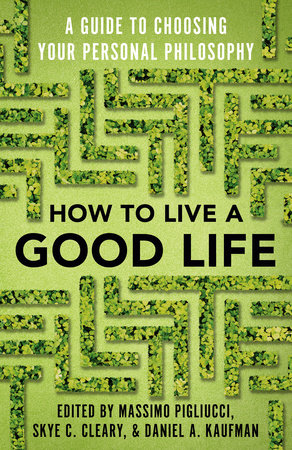
How to Live a Good Life, Edited by Massimo Pigliucci, Skye C. Cleary and Daniel A. Kaufman
Edit picked this up as soon as it came out and I got first go at it. Billed as "A guide to choosing your personal philosophy" it is a collection of essays written by practitioners of a range of practical philosophies and religions. Each philosophy is presented in brief, but through a personal lens. The book is divided into sections on eastern philosophies (Buddhism, Confucianism, Daoism), classical western philosophies (Aristotelianism, Stoicism, Epicureanism), "Religious Traditions" (Hinduism, Judaism, Christianity, Progressive Islam, Ethical Culture), and modern philosophies (Existentialism, Pragmatism, Effective Altruism, Secular Humanism). So it's certainly not exhaustive -- what book could be? -- but its range is broad and diverse.
Given the format, I figured I could probably dive in anywhere, so I went for the modern section, which caught my curiosity. Here, more than the rest of the book, I found the personal stories more interesting than the philosophy. Existentialism and Pragmatism are certainly presented a very personal searches, but Effective Altruism -- as on offshoot of utilitarianism -- seems the application of a formula. I was deeply impressed by the commitment and goals of its practitioners, while the philosophy struck me as somewhat bonkers. Secular Humanism seems as much a political manifesto as anything else, albeit one I'm probably signed on to.
Going back to the start of the book, I read on the eastern philosophies. Comparisons are often made between the classical western and eastern philosophies, and overall they do seem to have covered much of the same ethical space. I certainly found connections between all of them and Stoicism. The Buddhists and the Stoics are on the same page when it comes to anger (as the author himself noted). The Daoist focus on the impermanence of the world and going with "the flow" is inline with Stoic ideas, and in Confucianism I found a role ethics comparable with that found in the teaching of Epictetus.
Despite my partisanship, I enjoyed the defences of Aristotelianism and Epicureanism. I read with a mixture of fascination and disquiet the chapter on Hinduism: Stoics choose to give adversity meaning, but karma makes suffering positively valuable. Judaism seemed surprisingly relatable; the author explains that as the Hebrew Bible is not a philosophical text, they have to look elsewhere, resulting in a diversity of opinion that is embraced rather than lamented: "two Jews, three opinions". I was also interested to see that the writer of that chapter is a woman who decided at the age of fifty to become a rabbi, so it's never too late to change career.
I struggled with the section on Christianity. While the author felt hamstrung by the diversity of Christian thinking, is that really so different from any of the others? I found it vague and difficult -- particularly strange given that it's the one I'm most familiar with after Stoicism. "Mental maps" were mentioned on several occasions. The chapter on Progressive Islam was enthusiastic, and indeed sounded "Progressive", but I didn't get much of an idea about what drove it except the desire to be modern (which I in no way condemn).
I found myself surprisingly sympathetic to Ethical Culture, after initially internally deriding it as "religion for atheists". In particular I was interested in the way the author dealt with the unusual feature of having the founder of her movement, Felix Adler, alive within living memory. Despite apparently being a man of unusual integrity and drive, he was -- in part -- a man of his time (typically sexist). But the Ethical Culture participants are apparently able to embrace what was good and leave behind what was bad without rancour. I can imagine that there are those for whom classical philosophy will be lacking in form and ritual and would be right at home with Ethical Culture.
I left Massimo's section on Stoicism to last, and even contemplated skipping it as I thought I had a very good idea of what it would contain. But re-reading philosophy is a classic Stoic discipline, and the discussion of Enchiridion 1:5 was exactly what I needed today.
Overall, this is an enjoyable volume, which you can dip into or read cover to cover. If you're interested in thinking about how to live your life -- and you should be -- then this is worth a read.
Longer than a haiku, shorter than a monograph, all the credibility of the self-published.
Monday, 3 August 2020
Book Review: How to Live a Good Life
Saturday, 11 May 2019
Mother's Day Marcus Aurelius
Marcus begins his Meditations by reflecting on the various good influences on his life and giving thanks for them.
From my mother I learned to take people as I find them, to put aside my pre-conceived ideas and deal with the person actually in front of me. I also learned that we don't love people because they're perfect, to accept that our fellow humans have flaws and limitations which shouldn't blind us to the reasons we value their company. And from her devotion to her family and service to her community I have the ongoing example of a life well lived.
Thanks Mum.
From my mother, piety and beneficence, and abstinence, not only from evil deeds, but even from evil thoughts; and further, simplicity in my way of living, far removed from the habits of the rich.This Mother's day it seemed appropriate to engage in a similar exercise. So:
From my mother I learned to take people as I find them, to put aside my pre-conceived ideas and deal with the person actually in front of me. I also learned that we don't love people because they're perfect, to accept that our fellow humans have flaws and limitations which shouldn't blind us to the reasons we value their company. And from her devotion to her family and service to her community I have the ongoing example of a life well lived.
Thanks Mum.
Saturday, 21 April 2018
From Marcus I learned
I choose to do what is according to the nature of the rational and social animal
Marcus Aurelius was emperor from 161 AD to 180 AD, last of the so-called "Good" emperors. He was an skilled and vigorous defender of Roman law and of Roman borders. He also produced what is perhaps the most widely read Stoic text, his Meditations or To myself (claimed to be the more authentic title). Part of what makes Meditations so valuable is that rather than being a work of Stoic philosophy by a Stoic philosopher, it is an example of Stoic practice by a practising Stoic: a literal self-help book.
Some of Mediations was written at Aquincum, outside modern Budapest. Today the motorway is built on the ruins of the aqueduct, a rather literal example of letting the obstacle be the way.
He opens by giving thanks, acknowledging a series of intellectual or moral debts:
From my grandfather Verus I learned good morals and the government of my temper.and ways in which he has been fortunate:
I thank the gods....that when I had an inclination to philosophy, I did not fall into the hands of any sophist, and that I did not waste my time on writers of histories, or in the resolution of syllogisms, or occupy myself about the investigation of appearances in the heavens....Well, I clearly wasn't so fortunate! But Marcus is ready to educate me in the true business of philosophy: learning how to live well. Along the way, he refers to Socrates, Plato, Heraclitus, Homer, Hesiod, Euripedes and Epictetus (among others).
Much of the book is surprisingly relatable, given that it was written by a second-century Emperor. We have, for example, Marcus coaching himself out of bed:
In the morning when you rise unwillingly, let this thought be present: I am rising to the work of a human being. Why then am I dissatisfied if I am going to do the things for which I exist and for which I was brought into the world?And mentally preparing for dealing with other people:
Begin the morning by saying to yourself, I shall meet with the busy-body, the ungrateful, arrogant, deceitful, envious, unsocial. All these things happen to them by reason of their ignorance of what is good and evil.....I can neither be injured by any of them, for no man can fix on me what is ugly, nor can I be angry with my kinsman, nor hate him.Perhaps I am projecting, but I have a vision of a man preparing for a day of long, boring meetings with tedious people.
In any case, a section like that can be read two ways: standard motivational stuff or a serious philosophical statement. On the one hand, you can tell yourself, "I dread this, but it really isn't that bad -- it's not like anyone's going to draw knives and kill me!" And you'll probably feel better and you'll probably be right. That simple accessibility is no doubt part of Meditations enduring appeal. But, if one has some acquaintance with Stoicism, then this can also be read in a more specific way. According to Stoic logic, the only things that are truly good or bad are one's own decisions; other people can do unpleasant things, but they cannot make me bad: only I can do that to myself. It is in this technical, Stoic sense that Marcus says he cannot be "injured by any of them" and that "no man can fix on me what is ugly".
Death would appear to be never far from Marcus' mind, but I guess that's a defining aspect of the human condition. Here we see Stoic materialism:
Death is such as generation is, a mystery of nature; a composition out of the same elements, and a decomposition in to the same; and altogether not a thing of which any man should be ashamed, for it is not contrary to the nature of a reasonable animal...However there are more specific reasons for Marcus returning to this subject. Apart from the poor health he suffered from for much of his life, he experienced a recurring tragedy: of his thirteen children, eight pre-deceased him. Marcus sat at the very apex of his society, his children had access to the best housing, nutrition and medical care his society could offer; and yet they died.
It is a vulgar, but still useful help toward contempt of death, to pass in review those who have tenaciously stuck to life. What more then have they gained than those who have died early?....For look at the immensity of time behind you, and to the time which is before you, another boundless space. In this infinity then what is the difference between him who lives three days and him who lives three generations?Another recurring and important theme is the Stoic conception of humanity as fundamentally social. A thought such as:
That which does no harm to the state does no harm to the citizen.might seem rather self-serving for one who is the physical embodiment of the state. But, as ever, this was written to himself; he goes on
....if the state is not harmed by this, neither am I harmed.Called to the frontier to beat back fellow humans who had the misfortune to be born on the wrong side of the Danube, perhaps Marcus felt he would rather be elsewhere. But he knew his role in society, and thus his place. And although the Stoic is sufficient to him/her-self, one should also:
Be not ashamed to be helped; for it is your business to do your duty like a soldier in the assault on a town.
Despite the repetition and recurring themes, Meditations covers considerable philosophical ground. Consider:
Are you angry with him whose armpits stink? Are you angry with him whose mouth smells foul?....by your rational faculty stir up his rational faculty; show him his error, admonish him. For if he listens, you will cure him, and there is no need of anger.No lengthy classifications of body odour, or speculation as to its ideal form, just practical advice. And if he won't listen? Well, is it really possible that there be no poorly groomed people in the world? The ruthlessly practical logic of Stoicism is deployed in the cause of patience:
When you are offended with any man's shameless conduct, immediately ask yourself, Is it possible, then, that shameless men should not be in the world? It is not possible. Do not, then, require what is impossible. For this man also is one of those shameless men who must of necessity be in the world.Every village needs its idiot: the one before you is just faithfully fulfilling his role. In any case, Stoicism is a fundamentally forgiving (and self-forgiving) philosophy:
If a man is mistaken, instruct him kindly and show him his error. But if you are not able, blame yourself, or blame not even yourself.The actions of others are outside our control. The only things we truly can control are our own opinions, words and deeds, so
The best way of avenging yourself is not to become like the wrong doer.and
Take care not to feel towards the inhuman as they feel towards men.a mantra I find myself repeating daily as I read up on Australian politics.
But the signature feature of the Stoic, at least in the popular imagination, is the determination to cope with the situation at hand.
If you are pained by any external thing, it is not this thing that disturbs you, but your own judgement about it....And even if you are pained because you are not doing some particular thing which seems to you to be right, why do you not rather act than complain? But some insuperable obstacle is in the way? Do not be grieved then, for the cause of its not being done depends not on you. But it is not worth while to live, if this cannot be done? Take your departure then from life contentedly....Logic doesn't get more ruthlessly practical than that.
Severally on the occasion of everything that you do, pause and ask yourself, if death is a dreadful thing because it deprives you of this.When I read that I laughed aloud at its grim humour: if I die, at least I won't have to do this any more! But a friend pointed out the other side to this statement: if I die now, I won't finish this project. Like the dichotomy of control, then, it is a call both for action and for acceptance.
The first printed edition of Meditations appeared in 1558, but the manuscript it was prepared from disappeared soon afterwards, a terrifying reminder of the fragility of so much of our connection to the past. A further reminder appears in the Meditations itself, when Marcus advises us to:
Consider then what Crates says of Xenocrates himself.Indeed. Presumably he's talking about Crates the Cynic and Xenocrates the Academic, but what the former said of the latter is lost to posterity. But there are surprisingly few such obscurities. By contrast, the passage:
If any man is able to convince me and show me that I do not think or act right, I will gladly change; for I seek the truth by which no man was ever injured. But he is injured who abides in his error and ignorance.is a message for our age. I see a variation on Jurassic Park where people rather than dinosaurs are resurrected from their DNA. He's coming for you, Donald.....
But I am wrenched from idle fantasy by a reminder of the true purpose of philosophy:
No longer talk at all about the kind of man that a good man ought to be, but be such.
We are social cooperative organisms and we are rational. For Marcus, the secret to a good life lay in embracing those two facts of our biology.
....we are made for co-operation, like feet, like hands, like eye-lids, like the rows of the upper and lower teeth. To act against one another then is contrary to nature; and it is acting against one another to be vexed and to turn away.Let me then finish as Marcus started: by giving thanks. From Marcus Aurelius I learned to be patient with my fellows, and to live according to nature.
Friday, 5 January 2018
Free Will
Another of my exercises in understanding Stoic concepts, this time on the rather neat approach Stoics have to free will. Admittedly, the approach is to not talk about it, but rather talk about something better defined: volition. Volition is the ability to make decisions and act on them.
Stoics believe in a basically mechanistic universe: everything happens because of a chain of cause and effect, governed by rules which we can -- to some extent -- understand; and use that understanding to make better decisions. The effect that external influences have on individuals depends on their character.
There is a famous analogy called Chrisyppus' Cylinder. An object -- e.g., a cylinder -- responds to external forces in a manner dependent on its nature. So a cylinder, at rest on a flat surface, will stay there (Newton's first law). If something or someone should give the cylinder a push, it will roll. The push is external to the cylinder (and independent of it) but the rolling is a property of the cylinder -- it is in the cylinder's nature to roll. It follows that a person is buffeted by any number of external forces and responds according to their nature, whether the force is physical (trip and fall over), biological (grow a beard) or social (shave the beard off). And if I knew enough about a person and the forces acting on them, their behaviour would be completely predictable. Thus is life in a mechanistic universe.
But unlike the cylinder, a person is rational, in particular having the ability to reflect on their actions. This makes it possible for us to change aspects of our character.
For example: on a Friday night not so very long ago I went to the movies to see Thor: Ragnarok. Before heading into the theatre I bought a large glass of red wine. To anyone who knows me well, those choices would have been quite predictable: that on a Friday night when I had no pressing obligations I would go to see a movie, that I would see the latest Marvel release (I'm rather keen on them), that I would buy a glass of wine (I like wine), that I would choose red (it is my usual preference) and that I would ask for a large one (those movies are long).
Given the same set of external circumstances (a demanding criterion to be sure, but not an absurd one: Black Panther comes out it in February) and the same internal state, my behaviour would be exactly the same. But having reflected on the choices I made, I could choose to act differently in the future, swapping cinema for live drama (or staying home), Marvel for indy films, red wine for orange juice. My character would be thus changed, and I would accordingly respond (slightly) differently to external forces.
Monday, 4 December 2017
The Ethics of Cake
[The following is an exercise in coming to terms with making decisions according to Stoic principles, especially the dreaded Temperance. Obviously, one could swap out cake for any number of other pleasant things (wine, computer games, sex) but altering the surrounding text so that it still makes sense will not be equally easy in all case.]
Suppose that while visiting a coffee shop you see a bit of cake and you think to yourself "Cake would be nice." Then by all means eat the cake: in and of itself, cake is morally neutral. Its existence is neither an impediment nor an aid to Virtue: it is an indifferent. But it is pleasant and something you would like in your life, so it is a preferred indifferent (the language of modern Stoicism is, at times, comically technical).
But suppose instead that you see the cake and think "I've had more than enough fat and sugar today, I really don't need the cake", and then you eat it anyway! This would be a failure of Volition. Your Temperance has helped you set your priorities, you have formulated the appropriate response, but then you act in a manner contrary to your will. It seems your ethical muscles need training.
There might be other reasons to be suspicious of the cake. Perhaps you're concerned about the conditions under which it was made (exploited migrant bakers on dodgy work visas) or the provenance of its ingredients: are the eggs free-range? Your sense of Justice is helping you act in a way that will not compromise your character. Given that I said cake was morally neutral, it's turning out to be a real mine-field (welcome to virtue ethics).
Stoics seek to make the best decision "all things considered", balancing up different, competing requirements. In the case of meeting a friend for coffee, the cake is easily avoided if that is what you wish. But what if instead it is a friend's birthday cake? You might still decline, if your objection is strong, but you might instead conclude that your concerns about the cake are subordinate to the social role cake-eating plays. This is not necessarily a failure of Courage, just your Wisdom telling you that your friend's enjoyment of the occasion trumps your own obsession with your waist line.
[As I was writing this, I saw that a related (more general and far more expert) post had gone up at How to be a Stoic.]
Tuesday, 28 November 2017
Embracing Stoicism
tl;dr 1. I have decided to become a Stoic, 2. I have also decided to take up blogging again.
I was, in my youth, dismissive of philosophy. One of the things I liked about science was that you could argue all you liked, but ultimately there was the test: an experiment, and then we'd know who was right and who was wrong (and could move on to arguing about something else). With no conceivable test, philosophical arguments would just go 'round and 'round with no hope of resolution (or so it seemed to me).
But a few years ago I was asked to contribute to a course about science (scientific thinking and methods), taught to a group of students with a range of science interests. What physics could I teach when I couldn't rely on any physics background? I hit on the idea of recreating the "Scientific Revolution", the transition from Aristotelian thinking to classical physics. The basic phenomena are familiar to everyone and I figured this could be done with a short time devoted to theoretical discussions centred around some crude experiments. Bear in mind that my knowledge of Aristotelian physics was little more than the precis given near the start of any first year physics textbook, but this project appealed to my interest in history.
Armed with Aristotle's Physics, Galileo's Two New Sciences and Kuhn's The Structure of Scientific Revolutions I wrote my classes.* This required a lot of reading on my part, and with the Aristotle in particular I was starting from a standing start. So I went looking for supporting material that might help, and a web search produced the book Answers for Aristotle by one Massimo Pigliucci. It wasn't the book I was after (although it later proved profitable to me), but it lead me to his blog, Rationally Speaking. Pigliucci is an evolutionary biologist and a philosopher of science, but on this particular post he was discussing ethics. In particular, he used the term "virtue ethics".
I wasn't looking for an ethical system, but my interest was piqued by the fact he was daring to disagree with Peter Singer -- probably the only living philosopher I knew by name (and a fellow Aussie!) -- but also because the name "virtue ethics" somehow appealed to me. It was the start of a slow, but inexorable development of a new interest.
My receptiveness to philosophical reasoning was not a sudden thing -- in part I was just older and wiser -- and Aristotle and Kuhn had forced me to operate in a more philosophical space.** But I suspect Pigliucci's status as both a scientist and a philosopher gave his writing a certain credibility with me (apparently he was a Professor of evolutionary biology then did a new PhD and became Professor of philosophy!).
One of the most important results of this new interest was the decision to read a bit of Socrates. Plato's dialogues are rather variable: some of them are breezy reads, others are hard going. I picked one, more or less at random, and got quite a pleasant introduction. But before long, his hero Socrates had proven that religion doesn't define morality, trashed sophistry, and demolished the idea that might equals right. And his primary instrument throughout was rational argumentation. Perhaps my favourite bit (so far) is not a result, but a statement of method:
I was also struck by the example Socrates provides of a life worth living. Plato's dialogues, in particular the Symposium, paint a picture of a man who, despite his eccentricities, is loved and admired. He is hardy, brave, congenial and, above all, wise. And continues to be admired 24 centuries after his death.
Apart from the above I was broadening my horizons with casual readings on epistemology, metaphysics and ethics. Meanwhile, Professor Pigliucci (now blogging at Footnotes to Plato) had embraced Stoicism. This was, to me, an interesting development; but I was busy exploring a larger philosophical space. However, during a conversation with my partner, Edit -- sitting up in bed, discussing our daily business -- I suggested to her that she might like to check out "this Stoicism stuff that a guy I read has been going on about". Some of the things Pigliucci had been writing about seemed particularly relevant to Edit's concerns, so I pointed her to his blog How to be Stoic. She bought his book (of the same name) and devoured it; I was happy to have been of help, but was satisfied with my own path.
One of the problems I had with Stoicism was what seemed to me a streak of asceticism***: one of the four cardinal virtues is Temperance****. I have long seen enjoyment of worldly pleasures as central to a meaningful life -- what is life for, if not to enjoy it? But Stoics hold that Virtue is chief; anything else you might like in your life is a "preferred indifferent". Consider wine: I come from South Australia, source of 70% of Australia's wine output. I spend a significant fraction of my disposable income on wine (in fact, I would have denied that money spent on wine was "disposable"). I pay rental on a temperature controlled cellar. Yet Stoics would tell me that something so central to my life was an "indifferent". But what would I do for a really excellent bottle of wine? Kill? Rob a bank? Beat up someone's granny? Clearly the answer to all the above is no. In fact, if the focus of my life had been to procure money to afford luxuries, few of my choices would have made sense. So the Stoics were telling me that my priorities weren't really what I thought they were. And they were right.
Then philosopher Daniel Kaufman wrote a piece at The Electric Agora arguing that Stoicism isn't really what it seems. Stoics argue that Virtue isn't merely necessary for a good life, but sufficient. Kaufman contrasted this with the Aristotelian notion that Virtue is necessary, but so is luck: you need good things to happen to you. In his characterisation, Stoicism is rather a hedonic philosophy, aimed at helping its practitioners feel good about failing; a kind of religion for losers (my words). I found this a compelling attack, and was keen to read Pigliucci's reply, and to discuss it with my partner. Edit honed in on the same point as Pigliucci: pragmatism. The alternative to embracing Virtue is to accept that your life's value is determined by chance. I put forward the case that Stoics avoid the problem of failure by redefining it as success. She countered that some of the examples I was offering were false, because they were poor examples of Stoic decision making. A Stoic runner doesn't set out to win a gold medal -- that's clearly beyond their control -- so they don't then need a philosophy that helps them feel good about not winning a gold medal. I did the best job of arguing the contrary that I could, but that day I converted.
Anyway, the above is a rough reconstruction of several years' philosophical development, concluding about a month ago. I'm returning to writing in part because it's something I miss, but also because reflection is a useful stoic practice. I've never been one for a diary, but returning to blogging is perhaps a place to start. And, of course, I burn with the fervour of the newly converted :)
* Don't worry: the students also got instruction from an actual philosopher of science. Their education wasn't left entirely to the mercy of my dilettante efforts.
** The physics module for this course wound up rather different to my original (ignorant) intentions. I fell in love with Aristotle, discovered some really interesting medieval thinkers, came to appreciate how the way we respond to new information depends on what else we think we know, and developed a surprising sympathy for epicycles.
*** And, indeed, Stoicism is descended from Cynicism, the archetype ascetic movement.
**** The others (since you asked) are Courage, Justice and Practical Wisdom.
I was, in my youth, dismissive of philosophy. One of the things I liked about science was that you could argue all you liked, but ultimately there was the test: an experiment, and then we'd know who was right and who was wrong (and could move on to arguing about something else). With no conceivable test, philosophical arguments would just go 'round and 'round with no hope of resolution (or so it seemed to me).
But a few years ago I was asked to contribute to a course about science (scientific thinking and methods), taught to a group of students with a range of science interests. What physics could I teach when I couldn't rely on any physics background? I hit on the idea of recreating the "Scientific Revolution", the transition from Aristotelian thinking to classical physics. The basic phenomena are familiar to everyone and I figured this could be done with a short time devoted to theoretical discussions centred around some crude experiments. Bear in mind that my knowledge of Aristotelian physics was little more than the precis given near the start of any first year physics textbook, but this project appealed to my interest in history.
Armed with Aristotle's Physics, Galileo's Two New Sciences and Kuhn's The Structure of Scientific Revolutions I wrote my classes.* This required a lot of reading on my part, and with the Aristotle in particular I was starting from a standing start. So I went looking for supporting material that might help, and a web search produced the book Answers for Aristotle by one Massimo Pigliucci. It wasn't the book I was after (although it later proved profitable to me), but it lead me to his blog, Rationally Speaking. Pigliucci is an evolutionary biologist and a philosopher of science, but on this particular post he was discussing ethics. In particular, he used the term "virtue ethics".
I wasn't looking for an ethical system, but my interest was piqued by the fact he was daring to disagree with Peter Singer -- probably the only living philosopher I knew by name (and a fellow Aussie!) -- but also because the name "virtue ethics" somehow appealed to me. It was the start of a slow, but inexorable development of a new interest.
My receptiveness to philosophical reasoning was not a sudden thing -- in part I was just older and wiser -- and Aristotle and Kuhn had forced me to operate in a more philosophical space.** But I suspect Pigliucci's status as both a scientist and a philosopher gave his writing a certain credibility with me (apparently he was a Professor of evolutionary biology then did a new PhD and became Professor of philosophy!).
One of the most important results of this new interest was the decision to read a bit of Socrates. Plato's dialogues are rather variable: some of them are breezy reads, others are hard going. I picked one, more or less at random, and got quite a pleasant introduction. But before long, his hero Socrates had proven that religion doesn't define morality, trashed sophistry, and demolished the idea that might equals right. And his primary instrument throughout was rational argumentation. Perhaps my favourite bit (so far) is not a result, but a statement of method:
Agathon: I cannot refute you, Socrates. Let us assume that what you say is true.In other words, the relevant point is not who said it, but whether the argument is compelling. And if you've got a better one: let's hear it.
Socrates: Say rather, Agathon, that you cannot refute the truth; for Socrates is easily refuted.
I was also struck by the example Socrates provides of a life worth living. Plato's dialogues, in particular the Symposium, paint a picture of a man who, despite his eccentricities, is loved and admired. He is hardy, brave, congenial and, above all, wise. And continues to be admired 24 centuries after his death.
Apart from the above I was broadening my horizons with casual readings on epistemology, metaphysics and ethics. Meanwhile, Professor Pigliucci (now blogging at Footnotes to Plato) had embraced Stoicism. This was, to me, an interesting development; but I was busy exploring a larger philosophical space. However, during a conversation with my partner, Edit -- sitting up in bed, discussing our daily business -- I suggested to her that she might like to check out "this Stoicism stuff that a guy I read has been going on about". Some of the things Pigliucci had been writing about seemed particularly relevant to Edit's concerns, so I pointed her to his blog How to be Stoic. She bought his book (of the same name) and devoured it; I was happy to have been of help, but was satisfied with my own path.
One of the problems I had with Stoicism was what seemed to me a streak of asceticism***: one of the four cardinal virtues is Temperance****. I have long seen enjoyment of worldly pleasures as central to a meaningful life -- what is life for, if not to enjoy it? But Stoics hold that Virtue is chief; anything else you might like in your life is a "preferred indifferent". Consider wine: I come from South Australia, source of 70% of Australia's wine output. I spend a significant fraction of my disposable income on wine (in fact, I would have denied that money spent on wine was "disposable"). I pay rental on a temperature controlled cellar. Yet Stoics would tell me that something so central to my life was an "indifferent". But what would I do for a really excellent bottle of wine? Kill? Rob a bank? Beat up someone's granny? Clearly the answer to all the above is no. In fact, if the focus of my life had been to procure money to afford luxuries, few of my choices would have made sense. So the Stoics were telling me that my priorities weren't really what I thought they were. And they were right.
Then philosopher Daniel Kaufman wrote a piece at The Electric Agora arguing that Stoicism isn't really what it seems. Stoics argue that Virtue isn't merely necessary for a good life, but sufficient. Kaufman contrasted this with the Aristotelian notion that Virtue is necessary, but so is luck: you need good things to happen to you. In his characterisation, Stoicism is rather a hedonic philosophy, aimed at helping its practitioners feel good about failing; a kind of religion for losers (my words). I found this a compelling attack, and was keen to read Pigliucci's reply, and to discuss it with my partner. Edit honed in on the same point as Pigliucci: pragmatism. The alternative to embracing Virtue is to accept that your life's value is determined by chance. I put forward the case that Stoics avoid the problem of failure by redefining it as success. She countered that some of the examples I was offering were false, because they were poor examples of Stoic decision making. A Stoic runner doesn't set out to win a gold medal -- that's clearly beyond their control -- so they don't then need a philosophy that helps them feel good about not winning a gold medal. I did the best job of arguing the contrary that I could, but that day I converted.
Anyway, the above is a rough reconstruction of several years' philosophical development, concluding about a month ago. I'm returning to writing in part because it's something I miss, but also because reflection is a useful stoic practice. I've never been one for a diary, but returning to blogging is perhaps a place to start. And, of course, I burn with the fervour of the newly converted :)
* Don't worry: the students also got instruction from an actual philosopher of science. Their education wasn't left entirely to the mercy of my dilettante efforts.
** The physics module for this course wound up rather different to my original (ignorant) intentions. I fell in love with Aristotle, discovered some really interesting medieval thinkers, came to appreciate how the way we respond to new information depends on what else we think we know, and developed a surprising sympathy for epicycles.
*** And, indeed, Stoicism is descended from Cynicism, the archetype ascetic movement.
**** The others (since you asked) are Courage, Justice and Practical Wisdom.
Monday, 6 July 2015
And yet it moves
Through the internet one discovers that for any thought, there is someone who thinks it. Of course, some of the minority positions you see advocated are reasonable, or -- at least -- not demonstrably unreasonable. Topics where there is no widely accepted explanation, or where the mainstream explanation is not entirely satisfactory, are natural and legitimate fields for speculation. If the proponents are genuine and their ideas well informed, then engagement with fringe ideas can be an interesting and productive exercise; if the idea is completely juvenile (e.g. electric universe) then it is best left alone. Then there are fervent pseudo-skeptics and poorly motivated conspiracy theories, some of which were well known to me (climate change denial, moon landing hoax); others new, but follow a familiar pattern (HAARP). When it comes to scientific matters -- especially in areas where I have some special knowledge -- I occasionally take the bait, but I know better than to expect a good outcome. But recently I encountered a position that actually shocked me; stunned me. Perhaps it was because it involved both the rejection of well-established science and the invocation of a truly grand conspiracy. It seems we have been lied to all these years: the Earth is stationary!
At first, I wondered if the post (and, indeed whole identity of the poster) was satirical. After a bit of poking around, I concluded that was wishful thinking on my part. Then, a few weeks later, I saw something very similar from a different person. There's more than one person who thinks this! Few people will deny things that can be demonstrated in a simple and straightforward way: I haven't yet seen "Planes don't really fly - the airline industry is a hoax!". But even many basic aspects of the way we understand the world to work are not so simply demonstrable - they often require a level of trust (that the information you're being given is true) and an evaluation of multiple pieces of evidence for a most probable, parsimonious explanation. If one is inclined to be suspicious then one might reject the evidence, or one might dissent in the evaluation of the "naturalness" of a given explanation; neither is necessarily crazy. So I started to think about the evidence for the motion of the Earth, in an effort to evaluate how crazy it would be to reject it.
From the point of view of pre-modern astronomy (before the telescope) the motion of the Earth is particularly thorny because there is an almost exact symmetry between heliocentrism and geocentrism. The sky changes either because the Earth is stationary and the sky ("Celestial Sphere") moves, or the sky is stationary and the Earth moves. The two propositions produce exactly the same observations. Hence both Copernicus and Kepler had to defend themselves from charges of "novelty": simply coming up with a new model because they could. Of course, the ancients realised that a moving Earth would have some physical consequences, although they weren't entirely correct about what those would be. We can't really blame them for that - mechanics in a rotating reference frame is actually quite tricky. Nevertheless, they looked for such effects, didn't find any, and -- quite correctly -- concluded that the Earth was stationary.
The observation of Venus through a telescope by Galileo and others from 1610 onwards provided a genuinely new piece of information. Venus, as observed from the Earth, goes through phases just like the Moon does. The Ptolemaic model, the dominant pre-modern (and geocentric) astronomical model, was pretty vague about the relative positions of the Sun and inner planets, but no matter which way you arrange things you can't get it to produce a complete cycle of phases for Venus. The Copernican model was consistent with the observations of Venus, but so was another geocentric model, the model of Tycho Brahe. In the Tychonic model, the Sun orbits the Earth, and all the other planets orbit the Sun. However, the Tychonic model would soon lose out to convenience.
During the first quarter of the 17th Century, Johannes Kepler produced a heliocentric model based on ellipses, which proved to be far more efficient at describing planetary motion than the circles of the Copernican and Tychonic systems. The ephemerides he produced, the Rudolphine Tables, were so convenient that the astronomical community adopted heliocentrism despite its physical problems; but at that time it was still not clear that physics and astronomy would ever have much to say about each other. In other words: Kepler's model could be a convenient computational device without being a realistic model of how things actually work. That changed in 1687 when Isaac Newton published his Universal Theory of Gravitation. Newton provided a precise physical theory that explained Kepler's model.
All that is nice and, for the physics and astronomy communities at the end of the seventeenth century, compelling. But that is still not actual proof that the Earth itself moves. Before going further, we should specify the two types of motion required by Kepler's model. Firstly, the Earth must rotate: this provides the alternation of day and night, depending on whether the bit of Earth you're standing on is facing the Sun. Secondly, the Earth must revolve around the Sun: this produces the procession of the constellations across the evening sky over the course of a year.
Galileo had proposed that the moons of Jupiter could be used as a clock with which to determine longitude on Earth. This method was not useful on ships, where the required observations were impractical, but was successfully used on land. However, those who produced the necessary tables noticed a problem: sometimes their predictions were out a bit. Ole Roemer realised that if Earth and Jupiter orbited the Sun, then the distance between the two planets changed with time. If the speed of light were finite, then the time at which a particular Jovian moon would be observed in a particular position would depend on the travel time for the light. In 1676 he estimated that it takes light 11 minutes to travel from the Sun to the Earth: a bit slow, but of the right magnitude.
The clearest consequence of a revolving Earth is that of stellar parallax: the observed position of a star should shift over the course of the year as the position of the Earth changes. It was whilst looking for this that James Bradley discovered a more surprising, and subtle, effect: stellar aberration. In a series of observations from 1725 to 1728, Bradley observed an annual oscillation in the position of star gamma Draconis. In 1729 he published an explanation: the speed of light is finite (as demonstrated by Roemer), so for that part of the year when the Earth is travelling perpendicular to the direction of the star's light, the telescope moves while the light is travelling down its tube! This results in a shift in the apparent position of the star. From the size of the aberration he was able to deduce the relative speeds of the Earth and light, and hence the time it takes light to get from the Sun to the Earth: 8 mins 12 seconds. Not bad!
It turns out that the distances to the stars are so large, and therefore the angle of parallax so small, that it was not conclusively observed for another hundred years. It was Friedrich Bessel who finally made a positive measurement, on the star 61 Cygni, in 1838.
But what about the Earth's rotation? A freely falling object will experience an apparent deflection in the direction of rotation: the Coriolis force. This is somewhat counter-intuitive; it is perhaps useful to think in terms of conservation of angular momentum, e.g. the increased rate of rotation of an ice skater as they pull their arms in. In 1771, Giovanni Guglielmini dropped spheres from a tower. A fall of 241 feet resulted in an eastward deflection of about seven tenths of an inch! Artillerists would eventually have to correct for Coriolis force if they wanted to hit their target, and today it is central to our understanding of weather.
However, there is a simpler way to see the motion of the Earth. In 1851, Leon Foucault installed a large pendulum in the Pantheon in Paris. As the pendulum swings back and forth, the Earth goes through its daily rotation, rotating under the pendulum. The direction of the pendulum's swing, in terms of the room in which it is installed, changes. At the poles, the line of the pendulum's swing rotates 360 degrees per day; at the equator it rotates not at all.
Today we live on a planet surrounded by artificial satellites; we routinely use them for communication and navigation. The Gaia observatory uses parallax to measure the distances of stars tens of thousands of light-years away. We have sent probes to every planet in the solar system, and New Horizons is starting the exploration of the Kuyper belt. But what do these things matter to the true crackpot!? The history of science is all lies: the above remembrances ignore the many contradictory results. And the reported effects are tiny, dependent on expensive equipment and the product of elite knowledge. The various space programs of all those countries: lies. Why should all those people, irrespective of nationality, politics or religion engage in a multi-national, multi-generational conspiracy? I don't know, but I'm sure someone does!
Well, our crackpot could find a Foucault pendulum and spend a few hours observing it, if they have the patience; but they might suspect some interference. There is usually some driver to keep the pendulum going. They might build one themselves, but ensuring it swings straight is tricky, and it will need regular re-starting.
Instead, how about the old water swirling down the drain phenomenon? The notion that the direction a water swirls out a sink/toilet/bath is determined by which hemisphere it's in (via Coriolis) is a myth: local conditions -- the way the water was poured in, the shape of the basin etc. -- dominate. But, if the experiment is performed carefully, Coriolis can produce the expected effect. This is beautifully demonstrated by Derek Muller and Destin Sandlin in a pair of Youtube videos: https://www.youtube.com/watch?v=ihv4f7VMeJw and https://www.youtube.com/watch?v=aDorTBEhEtk (I recommend going to the effort of synchronising the videos - it really is pretty cool). I think most of us would be happy to accept that this is a true record of an honest and competent experiment, but the experiment is simple enough that the skeptic could perform it at home, at least for one hemisphere. Perhaps the skeptic travels, or perhaps they know someone they trust in the other hemisphere, who could repeat the experiment there. Maybe they could find someone on the internet - you meet all sort of people there.
Thursday, 27 March 2014
Pakeha
Note: The inconsistent use of macrons in this article is not a reflection of their linguistic importance, but only of the laziness of the author.
Thursday, 4 October 2012
Dredd, and loving it.
The appearance of another Judge Dredd film has caused me to re-activate my status as Dredd fanboy. I first encountered Judge Dredd when I was about 10 in a Best of 2000AD comic, and, as far as introductions go, I lucked out. It was the story introducing Judge Death, one of the particularly memorable (and one of the few returning) baddies. This story also introduced Judge Anderson of the Psi division. I had never been much of a comics reader and I was quite shocked -- and fascinated -- by how dark and violent it was: I had no idea comics could be like that. But that wasn't what kept me coming back.
The world that Dredd inhabited seemed frighteningly plausible (and, perhaps, does again). Humanity crammed into super-cities, much of the planet uninhabitable, unemployment the norm. Laura Norder has trumped all other political considerations leading to the creation of the Judges: a "super police" who both apprehend the criminal and sentence them on the spot, dispensing with the red-tape of trials, lawyers and juries. And the high-density idle humanity keep them very busy. The people of Megacity One as usually seen in colourful, "future punk" clothing (with the notable exception of Max Normal "the pin-stripe freak") and consume their time on earth playing Pin Boing, flying (often unsuccessfully) in bat suits, high-altitude graffiti, growing fantastically fat, or indulging in bloody inter-neighbourhood "block wars".
The necessity of extreme measures to maintain order often make Dredd a morally non-trivial character. Dredd is a clone of the founding Judge, Fargo, and a legend even among the Judges; he is ethically (almost) one-dimensional, utterly devoted to the maintenance of The Law. This means he can function as both anti-hero and hero. The characteristics that make him a superlative Judge do not make him a nice person. Whilst sometimes the plots are of Earth-shattering significance, often they're not. One of my favourites involves Dredd chasing a litterer.
And his adventures are often delivered with straight-faced black humour.
Fortunately, I only found out about the new movie quite recently, because I've found the subsequent wait interminable. A good friend got tickets to the Auckland preview, which was greatly enhanced by finding the star, Karl Urban, tearing the tickets at the door! But how did I find the film?
The cast was generally good and the leads were great. Visually, it was bland and grimey. The streets were relatively empty and the vehicles slightly old fashioned; with perhaps a late 80s theme to the movie in general. The exceptions are the Judges and their equipment, which is slightly futuristic. Dredd's Lawmaster looked good. The cityscape is modern but rundown, with a giant skyscraper ("Block") on every city block. Most of the film occurs inside one of these Blocks, and it looks like a very tall version of the impoverished housing developments popular in British crime drama. I think the intention was to depict a civilisation halted by catastrophe, and to create some "immediacy" by having it look mundane, but for me it just looked half-assed, like the main characters were wearing costumes, but no one else was. Certainly the Block was not convincing as a place where one could lead his whole life.
We were promised graphic violence and it was provided in buckets, with gruesome deaths, unpleasant images and 3D sprays of cgi blood. The little ritual from the comic where Dredd announces the type of bullet before firing was fortunately preserved (but no ricochet -- my favourite). Anderson uses her psi powers to good effect, and despite her inevitable capture doesn't need rescuing. Dredd's script is kept suitably brief, almost like the comic. Occasionally, just occasionally, there's a slight delay, as if there is thought behind the mask; its entirely enough. The film has the plot of a platform game, the goal being to get from the bottom to the top, but it's a reasonably entertaining trip. The mid-film surprise is not a plot twist, but a demonstration of the bad guys' (and film makers') cavalier attitude to humanity. It doesn't matter: it's still shocking.
The film Dredd gets the characters right but, like the previous Stallone version, gets the backdrop wrong. The lunacy of life lead under extreme conditions is forgotten, instead we get a vertical slum. Judge Dredd is a double act, the Judge is one half, the City the other. Neither film adaptation has properly understood that. I was left disappointed by the wafer thinness of plot, but only later realised that Dredd is an anomalous action movie: it's actually character driven. Dredd works because the relationship between Dredd and Anderson works, because Anderson's conviction in her own worth grows sufficiently slowly that it actually is a process. True to the comic, there are no stirring speeches, just trial by fire.
I enjoyed the movie, but while watching the credits I couldn't imagine watching it again. Twenty four hours later, I'm keen to revisit it, to see it what I think is there really is.
Friday, 17 August 2012
100% Unemployment
A while ago I heard a seemingly radical proposal. Instead of having unemployment benefits, carers' benefits, disability pensions, the old-age pension and so on; just pay everyone in the country a universal allowance. The main motivation of the proponent was to remove the stigma associated with some of these (especially unemployment), however what struck me was the efficiency of such a scheme. It would be (more or less) fiscally neutral as wage earners would have their allowance taken back through increased income tax. Despite the churn (the government handing out money and, in most cases, taking it straight back) it would lead to the abolition of a significant chunk of the public service: all that chasing job seekers and assessing disability claims would be unnecessary. Needless to say, the political leaders of this great nation showed no sign of being inspired by this idea.
I thought of it again recently, however, in a rather different context. The usual urging to greater efficiency and productivity in the private sector, and cutting of costs in the public sector have been steadily growing louder as the global economic environment continues struggle. I think few people appreciate that "increased efficiency", "improved productivity" and "cost-cutting" are all euphemisms for "sacking people", both directly and indirectly (e.g. using less printer paper, forcing the paper supplier to sack people). Of course, in some countries the meaning of the word "austerity" has become quite transparent. However, all this is true in good times as well as bad. An improvement in productivity (such as one driven by technological innovation) means a decreased need for labour, once the need for that good or service is close to saturated. Innovation, organisation, efficiency: these are the natural enemies of employment.
The fact that near-universal unemployment is an inevitable result of a technological civilisation is no revelation. Whether it's the utopian vision of Star Trek, where the combination of advanced technology and social innovation has liberated humanity from the need to work; or the dystopian visions of Brave New World, where innovation is suppressed so as to maintain the need for menial labour, or 1984, where perpetual war consumes production so that it cannot benefit humanity; this is a well-explored idea. A more mundane scenario is offered by Judge Dredd, where near total unemployment leads to increased crime (and suitably draconian measures to control it) and the popularity of impressively reckless hobbies. One memorable Judge Dredd story involved a riot sparked by rumours of a job opening as a "human canary" at a gas plant. The canary just sits around all day, but if he or she suddenly keels over then the robots know there's a gas leak.
Whilst unemployment rates rise and fall according to local and global fluctuations in economic activity, it's possible we are already entering the phase where growth in production overwhelms growth in demand. As Guy Rundle pointed out -- in a report on the global financial crisis -- much of the economic activity of developed countries already consists of selling coffee to each other. The incredible growth over the last century in executive wages (as multiples of the average wage) is well documented. There are, no doubt, many factors in this: one being a disconnection between the interests of the company and those of the people running it, leaving the foxes in charge of the hen-house. But it's possible that we are already seeing the narrowing of the pyramid of production, with (relatively) fewer staff involved in actually producing and distributing goods and services. Those profits have got to go somewhere, and they're winding up at the top. Do we follow this to its logical conclusion, when developments in technology and infrastructure (both physical and social) mean that the profits of production are entirely in the hands of the person who owns the machine that makes everything, and the chief technician who pushes the button?
Sooner or later we will have to make the transition to a society where employment -- in the sense of each individual needing to work to sustain themselves -- no longer exists. This will involve massive challenges, as it means that the people of that future civilisation will need to be motivated by rather different causes than the bulk of today's humanity. This will also require further changes in the way we control production, to distribute the spoils of production in an equitable way that still rewards those responsible for production. Abolishing the kind of "hand outs" mentioned above in favour of just paying everyone a "dividend" -- a share of the collective production -- seems a modest step in that direction.
Thursday, 2 August 2012
Valkiwi
K. and I went to the NZSO's concert production of Valkyrie on Saturday
night. Valkyrie might well be my favourite opera and I was really
looking forward to this given what a success the Auckland Philharmonia's
Rheingold was last year.
The stage was crammed full of musicians, with just a bit of space left for the singers up front. When the first violin came out to tune-up the orchestra it was clear that this was going to be good: they were all together, no messing about. I confess that after Rheingold I was slightly apprehensive about the brass during the 1st act prelude, but there was no need to be: these guys were good.
Although it was just a concert production, the cast made considerable effort to include as much action and acting as possible. I was actually getting nervous about the singers' entrances as the prelude was coming to a close -- my usual experience of concert productions is that the singers sit up-front throughout -- but sure enough our Siegfried appeared in time, as did our Sieglinde a little while later.
The cast was uniformly excellent, but Edith Haller (Sieglinde), was the stand-out for both of us. She was delightful to watch on stage, at turns playful and reserved; and she sang with incredible power and beautiful tone. I particularly liked the way she sang her brief low sections ("ein Greis in grauem Gewand"), but she effortlessly leaped into the big stuff too ("O hehrstes Wunder! Herrlichste Maid!"). The brass was a little tentative in the prelude to act 2, and it would have been nice to have another hunting horn or two in the finale to act 2, but I guess you can't have everything. We did get nearly an hour and a half for dinner, which was appreciated. We dashed down to Vivace (a regular haunt) and the Valkyrie programmes visible on nearby tables showed that it was popular choice.
The prelude to act 3 was as tight and tidy as I've ever heard, with the front of stage filled with a great cast of valkyrie managing to look suitably amazonian even in the usual concert evening-wear. Again, despite the concert setting, they did a great job Brunnhilde's approach, apparently watching her and Sieglinde rushing in from a distance, generating real drama from the cry that Grane has stumbled. Sieglinde's exit led K. to suggest that, despite the incredible barrage of valkyrie and orchestra we got at the start of the act, Haller could have sung over top of the lot. In the finale, the inclusion of some red lighting suggested the flames that surrounded Brunnhilde; a nice touch.
The strength of this production is perhaps best summed-up by saying how engaging all the lengthy dialogues were; these are a challenge of both singing and acting, requiring tight integration with the orchestra. Tchaikovsky complained of "endlessly long dialogues"; but on this night, there was just great musical drama.
Tuesday, 27 March 2012
Spiesser
A while ago, some German colleagues introduced me to the word "spieĂźer". I didn't know who they were describing, but it was clearly pejorative. Failing to think of an adequate translation, they attempted to explain its meaning. The origin story -- as it was told to me -- dates to the seventeenth or eighteenth century. The basic grunts of the Prussian army were pikemen, the German for which was "spieĂźer". (My amateur philology, unencumbered by either training or a solid knowledge of any language other than English, leads me to conclude that "spieĂź" is the German reflex of English "spit", i.e. a long pointy stick.) Those selected to be spieĂźer (as opposed to cavalry or officers) were the least educated of the available recruits, so the term came to be derogatory, associated with people of little sophistication. One usage example offered was of some relatives, who always ate their dinner at a certain time, not because it was particularly convenient or pleasurable, but simply because they lacked the imagination to do otherwise.
I suggested "bourgeois" as a possible English (*cough*) equivalent, and indeed Wiktionary offers:
Update: Another blogger sharing the love for "spieĂźer".
I suggested "bourgeois" as a possible English (*cough*) equivalent, and indeed Wiktionary offers:
- (pejorative) square (socially conventional person)
- (pejorative) philistine (person who lacks appreciation of art or culture)
- (pejorative) bourgeois (individual member of the middle class).
Update: Another blogger sharing the love for "spieĂźer".
Friday, 13 January 2012
Swift on Prime Ministers
A great little quote from Gulliver's Travels
....First or Chief Minister of State, the description of which, as far as it may be collected not only from their actions, but from the letters, memoirs, and writings published by themselves, the truth of which has not yet been disputed, may be allowed to be as follows: that he is a person wholly exempt from joy and grief, love and hatred, pity and anger; at least makes use of no other passions but a violent desire of wealth, power, and titles: that, he applies his words to all uses, except to the indication of his mind: that, he never tells a truth, but with an intent that you should take it for a lye; nor a lye, but with a design that you should take it for a truth; that those he speaks worst of behind their backs, are in the surest way to preferment; and whenever he begins to praise you to others or to your self, you are from that day forlorn. The worst mark you can receive is a promise, especially when it is confirmed with an oath; after which every wise man retires, and gives over all hopes.
Thursday, 10 November 2011
Democratic Elections (Part 3)
And finally we get to the method New Zealanders know [?] and love [??], the Mixed-Member Proportional system. I noted at the start some surprise that NZ had enacted such a major reform as the adoption of a completely different electoral system; but it was motivated by possessing possibly the worst system in the democratic world: First Past the Post election of a unicameral legislature. In 1993, Kiwis changed to a very different beast.
Mixed-Member Proportional (MMP)
The most important feature of MMP is that it is proportional: seats in the parliament are assigned to parties in proportion to the percentage of the national vote that each party receives. The actual way that is worked out is by the Sainte-Laguë formula, and the final result is, indeed, pretty proportional. There are, however, some twists and turns.
There are approximately (see below) 120 Members of Parliament, which works out to 0.83% of the vote per MP. The first twist is that there is a threshold of 5%, i.e., in order for a party to get any Members of Parliament, it must get at least five percent of the vote. This stops the parliament from being fragmented into many small parties, Italian style, but whether it's a fair barrier to participation is questionable, especially as preferential voting is not used. As we'll see, this barrier exists for some, but not for others.
The next twist is that rather than being just a party-centred proportional system, there is also a level of regional representation built into MMP. Seventy MPs are, in fact, "Electorate" MPs: they are elected to represent a particular electorate by a first past the post vote. This doesn't mess with the proportionality of the system (mostly: see below!), because each Electorate MP counts against the party's total allocation. The rest is made up from "List" MPs.
So at the ballot box, each voter has two choices to make: the party they want to vote for and the local electorate candidate they want to vote for; one voter, two votes. To first approximation, the electorate vote is irrelevant: the total number of MPs the party gets is determined by the party vote, exactly which electorates they represent -- or whether they come in on the List -- is a matter of shuffling the chairs. But for small minor parties the electorate vote can be very important: winning an Electorate seat means dodging the 5% threshold.
In the 2008 election, for example, the ACT party received 3.65% of the party vote, less than the threshold; but one of its candidates, Rodney Hide, won the seat of Epsom, thus defeating the threshold. ACT's party vote was enough to elect 4 additional MPs. Another party, New Zealand First, received 4.07% of the party vote, but won no Electorates, and therefore received no MPs. The Maori Party only got 2.39% of the party vote, but won 5 Electorates, so its representation in the parliament was much larger than its party vote required (3 seats)! This, by the way, is why the number of MPs is not fixed. The Maori Party excess means there are currently 122 MPs; an "overhang" of two. So once again we see that concentrated regional support trumps broad, thin support.
The main problem with this is not so much the discrimination between parties (though I'm sure Winston Peters would disagree), as the discrimination between voters. As we've seen, the "one voter, two votes" of MMP is really just "two ticks, one vote" for most voters. But some voters -- those in the Maori Seats and the Good People of Epsom -- actually do get two votes!
Renowned Aussie psephologist Malcolm MacKerras explained this a worthy rant some time ago, and this election this exploit is very much in the public mind. However, the complaint being made by the SM proponents is very different. What upsets them about MMP is that it is difficult to get rid of a particular parliamentarian. If they lose their Electorate, because they're out of favour with their constituents, but are still in favour with their party then they come into parliament as a List MP. This is a consequence of the party-centred philosophy of MMP, as opposed to the candidate-centred philosophy of STV.
MMP is designed with the expectation that voters vote for a party, whilst STV allows voters to vote for an individual. While it is true that modern politics in much of the world, and certainly in New Zealand, is based on the party, objections to particular members are not that uncommon. The example that springs to mind is Larry Anthony, turfed from the seat held by his father and his grand-father despite the overall swing to his party. This would be almost impossible in MMP. The voters' inability to rid themselves of unpopular politicians is a fair complaint, however the correct solution is to opt for STV, not SM.
Summary
First Past the Post
- Pro: Voters feel they understand it.
- Con: They don't.
- Pro: Can vote for the candidate you want.
- Con: Overwhelmingly favours the largest parties.
- Pro: Better than FPP.
- Con: Not better enough.
- Pro: Preferential and (approximately) Proportional.
- Con: Complicated.
- Pro: Proportional representation.
- Con: Not preferential, favours voters in some electorates.
Tuesday, 8 November 2011
Democratic Elections (part 2)
Continuing our psephological journey we look at Single Transferable Vote (STV) and Supplementary Member (SM). But first I'd like to point out one of the challenges of this discussion. The proposals blend two things: the voting method, and the thing you're voting for. In the two proposals I discussed last time, First Past the Post (FPP) and Preferential Voting (PV), the only difference between them was the voting method; both proposals are for single member electorates. The next two systems -- STV and SM -- include multi-member electorates. One of them uses preferential voting (note the lack of caps) and the other uses first past the post (ditto).
Single Tranferable Vote (STM)
Unlike FPP and PV (but like MMP), Single Transferable Vote is a proportional system, i.e. it is constructed so that representation in the parliament is (roughly) proportional to the number of votes a team gets. So if a third of people vote Green, a third vote Labour and a third vote National, that's how the seats in the Beehive will be handed out. Of course, all the proposals look reasonable at first glance, so let's look at the details.
Suppose New Zealand gets divided into 24 electorates, each returning 5 Members of Parliament (it looks like it won't actually be quite that neat, but anyway). That means that each electorate will have around 100,000 voters. In order to be elected each candidate will need just over one sixth (for five members) of those votes, i.e. roughly 17,000 votes. That number is called the "quota". So if you like a candidate, and so do 16,999 of your fellows in that in electorate, then s/he can win a seat. Note that this is a much easier challenge than trying to convince half of the voters in an electorate.
So far it's pretty simple. The main complexity of this system comes from the fact that it is preferential as well as being proportional. In part, that's because there has to be a way to deal with surplus votes. For example, suppose a candidate gets 20,000 votes. That's more than quota, so that candidate gets elected, but what do you do with the extra 3,000 votes? The STV solution is this: the voter numbers every candidate from 1 (first preference) up till every candidate has a number. Each candidate's "1"s are added up. Any who have quota are elected, and the surplus distributed in order of preference, i.e. to whichever candidate is marked "2" on each ballot. The process continues till 5 MPs (in this example) have been found. The counting and distribution of preferences in a little technical, a more detailed description is provided by the AEC.
So the advantages of STV are that it is both proportional -- so highly democratic -- and preferential, so voters can vote for the candidate they actually want. It also has the advantage of not suffering from what seems to be the major complaint against MMP: because you can vote for individuals, you can vote individuals out. There's no coming back in on a list!
The most obvious disadvantage of STV is its complexity. In addition to the complexity of the system itself (and few people really understand any of these systems) the voter is often confronted by a ballot containing many candidates. At the 2010 Australian Federal election, South Australian voters faced a ballot paper containing 42 candidates (to elect 6 Senate members). Rather than insist that the voter number every one of the 42 candidates, Australian voters have the option of voting "above the line", outsourcing their preferences to one of the parties (or other ticket). So in NZ, it would be possible to vote National, for example, saying you're voting the way the National Party would like you to vote. In effect, it would be much like the Party vote in MMP. This desire to offer a simpler voting option does, of course, complicate the ballot: two ways to vote on the one piece of paper!
A particularly dramatic corner case for STV occurred in the 2004 Australian Federal Election. This election saw a turf war between the Labor [sic] party, the Democrats and the Greens. In an effort to slow the rise of the Greens, Labor and the Democrats both directed Senate preferences to Family First, a new conservative party. In the state of Victoria, the trickle of preferences was actually enough to elect Family First candidate Steve Fielding with just 2.63% of the first preference votes! The election of Steve Fielding was a clear failure of the system (and I'm talking purely about voter intention, not his merits as an MP), but one that required a very special collection of circumstances, including the use of above the line voting.
Supplementary Member (SM)
We could just slander SM by pointing out that it's the system used in Japan, possibly the most politically unstable of the developed nations (Japan has chewed through five Prime Ministers in the last four years, and 12 in the last 20). But that would be childish, so let's give SM a fair trial before, umm...
As I alluded to above, there are basically two competing psephological ideas: single member constituencies and multiple member constituencies. FPP and PV adhere to the first, while STV and MMP use the second. Supplementary Member is an attempt to blend the two ideas (in a way, so is the combined use of PV and STV in Australia). In New Zealand, there would be 90 electorates where the MPs would be chosen by first past the post -- "Electorate MPs" -- and then 30 members chosen proportionally (also by first past the post, but in multi-member electorates it's called Single Non-Transferable Vote), called "Supplementary MPs".
In practice, voting would be much like in MMP, with an electorate vote and a party vote, but the relative importance of these would be swapped. The Electorate seats would behave just like they would in FPP, and the major parties would also get the lion's share of the Supplementary seats, relegating the minor parties to fighting over the scraps. The Supplementary MPs would presumably be allocated using the Sainte-Laguë formula, but the Electoral Commission's website doesn't explicitly say so.
There are some nice examples comparing SM to MMP in actual elections at Kiwiblog, but the usual effect is to amplify the influence of the strongest single party and diminish that of everyone else. Some would see that as a positive, in that it tends to generate decisive results, but then, so does a coin toss. SM is neither proportional nor even preferential.
Partial Conclusion
At first sight, Supplementary Member presents an elegant compromise between the ideologies of single vs multi member electorates, however the rump of 30 Supplementary MPs will have little effect on the body of 90 Electorate MPs, especially as most of them will belong to the major parties. Voters might seek insurance by voting for a major party in the Electorate, and a minor party in the Supplementary seats, much as many Australians do by voting for different parties in the House of Representatives and in the Senate; however under SM this strategy will not be as effective, as all the MPs sit in the one house. In short, this is a dollied-up version of FPP, and has the same flaws.
Single Transferable Vote is much more democratic. It is not strictly proportional in the way that MMP is, but does allow the voter to pick and choose from the available candidates, instead of leaving it to the parties. And under STV everyone gets one vote, while in MMP some get two (more on that next time). STV incorporates preferential voting, which means voters can vote for the candidate they want without being "tactical"; but the inclusion of "above the line" voting (or "party" voting, Kiwis might call it) encourages some devious strategising by the parties. Of course, most of the time such details have little effect anyway.
Next time: Mixed-Member Proportional and Summary
Friday, 4 November 2011
Democratic Elections (part 1)
I had been under the impression that significant political reform generally required somebody getting shot; but in New Zealand, not only can the electoral system change with a vote, it actually does. In 1993, NZ adopted Mixed-Member Proportional representation (MMP) -- the system used by the Germans -- and at this year's general election Kiwis will be asked if they would like to change it again. The referendum will have two questions, firstly, should New Zealand keep MMP? and secondly, if NZ were to change, which of a list of four other systems should it use?
I decided to look at each of the alternatives on offer:
First Past the Post (FPP)
Initially, I wasn't planning to spend any time on this one as it's an incredibly silly system, but given that the Poms actually managed to vote for it earlier this year, and polls show it's the second most popular option in NZ, it would seem to be worth a few words.
In this proposal the country would be divided into a number of single member electorates (120 of them), and the winner of each is the candidate who gets the most votes. Simple. But if there's more than two candidates, there is a real risk of returning the wrong result, because no one needs fifty percent of the vote. A candidate despised by sixty percent of the electorate can win. While two party politics dominates many (most?) democracies, three way contests are not that uncommon, either at the national level -- consider the UK (Tories vs Liberal Democrats vs Labour), or Canada (Conservatives vs Liberals vs New Democrats) -- or at the electorate level, and we'll see a new example of that in New Zealand this year (Maori vs Labour vs Mana). And then there is always the Greens.
One of the more famous demonstrations of the flaw in this method of voting comes from the 1992 US presidential election where Ross Perot split the conservative vote. Bill Clinton won with 43% of the vote, when George Bush Senior was almost certainly the more widely preferred candidate.
Actually, the most insidious aspect of FPP is not the contests it gets wrong, but the contests it prevents from happening at all. There is little point in voting for a candidate that few others vote for - the vote is "wasted". Instead, the voter is encouraged to second guess the intentions of other voters, throwing support behind a candidate he expects to be competitive with whomever it is he really doesn't want. Hence the controversy surrounding any of Ralph Nader's electoral tilts. But lousy though FPP is at dealing with individual competitions, it actually has a much bigger problem, which it shares with the next system to be discussed.
Preferential Voting (PV)
Question: How do you spot an Australian? Answer: They're the one trying to explain preferential voting to the person next to them.
As an Australian, I regard preferential voting as my birthright, and it's certainly a practical corrective to the problem described above. Given a list of candidates, the voter marks their preferred candidate with a "1", the next with a "2" and so on, saving the highest number for the most despised candidate on the list. Or, if you prefer, decide whom you dislike the most and work backwards. Counting is performed by determining which candidate has the least number of "1"s, eliminating that candidate and distributing those votes to all the "2"s. This process continues until one candidate has more than 50% of the vote. The voter can actually support the person they want, without it directly serving the person they least want.
However, PV shares the biggest weakness of FPP: single member electorates. Consider the following thought experiment: Party A gets a uniform, nation-wide vote of 50.1% (either first preference or two-party preferred, it doesn't matter). This would lead to that party winning 100% of the seats! While the example is extreme, the phenomenon of individual parties dominating a parliament on slender majorities -- or even considerable minorities -- is not. Consider the 2005 UK election in which Labour won 355 seats in the House of Commons with a mere 35.2% of the vote. The Tories and Liberal Democrats, with a combined 54.4% of the vote managed just 260 seats between them. Minor parties can thrive in such a system if they have strong regional support, but not if they have broad support. So, for example, the Democratic Unionists (Northern Ireland) were able to convert their 0.9% of the vote into 9 seats, while the Greens were unable to gain any seats despite 1% of the vote. So in New Zealand, PV will suit the Maori Party just fine, but at considerable cost to the Greens.
A similar disparity exists between the Nationals and the Greens in Australia, although there the excess of single-member electorates is partly mitigated by having a bicameral legislature, with the Upper House selected using a system of proportional representation, Single Transferable Vote, which I shall discuss next time.
Partial Conclusion
The perfect electoral system accurately reflects the intentions of the voters, but if that could be perfectly defined then the hunt for a system would be over. All the systems so far devised have their quirks, and can fail at corner cases. But the fact that there is no one right answer does not mean that there are no wrong answers, and both FPP and PV are, in this context, wrong answers. Preferential Voting is a good way to resolve individual contests, but by itself cannot overcome the flaw of single member electorates (although it does push things in the right direction, which is why the outcome of the UK referendum was gobsmacking). The remarkable thing about FPP is not that it fails sometimes, but that sometimes it doesn't fail.
Next time: Single Transferable Vote and Supplementary Member
Thursday, 3 November 2011
Scepticism
On the 23rd of September, the OPERA collaboration announced that they
had measured the speed of neutrinos travelling from CERN to their
detector at Gran Sasso, and that it exceeded the speed of light by
0.00002%. The announcement was met with excitement and enthusiasm, but
the dominant view amongst physicists seems to be that it is due to some
-- as yet unidentified -- systematic error. Some have sought to draw a parallel between this scepticism, and the opposition to action over climate change.
Four ways in which scepticism about superluminal neutrinos is unlike scepticism about climate change.
- It's new: All new, as yet unverified results should be treated with a healthy dose of scepticism. OPERA released its preprint just over a month ago. The current understanding of global climate change and its possible causes is the result of decades of work.
- It's weird: Neutrinos travelling at more than the speed of light is difficult to reconcile with a wealth of well-established science. On the other hand, carbon dioxide is known to act as a green-house gas, and this behaviour is well understood. While it might be surprising that net human emissions have been great enough to make a difference, it does not pose a problem for fundamental science. Not all claims are equal.
- It's the scepticism of peers: The scrutiny that the OPERA result is receiving is led by physicists, people who understand something of the strengths and weaknesses of such experiments and can put the result in context. Climate change scepticism is led by commentators, particularly in print and radio. Of course, there is also one particularly committed comedic performance artist, and a Catholic cardinal!
- It's not a threat: the confirmation of superluminal neutrinos would be truly monumental, and might lead to revolutionary discoveries and technologies. However, it would have little impact on the way people live for the foreseeable future (short though that might be). The possibility of anthropogenic climate change, however, presents a direct challenge. Even modest changes in weather patterns will affect land use, agriculture, the prevalence and spread of certain diseases, and the way many of us live. Studies have repeatedly shown that the cost of mitigating action is modest compared to the potential cost of inaction - a clear case for taking out insurance. The case for action on climate change doesn't require "proof", just the existence of a credible threat.
Believing Nonsense
In an article in Crikey
(paywall), Noel Turnbull asks why we believe so much that’s wrong: "One
of the great conundrums of modern life is how so many people have come
to believe so much that is just plain wrong." He goes through some fun
facts, such as the research that showed that the more you watch Fox
News, the more ignorant you become. This reminded me of a claim about
human cognition I encountered back when I was a student: it's easier to
accept new facts than to discard old ones.
I don't remember who wrote the book, but it was someone famous and I think it was about the development of the GSW electroweak theory. The above claim was followed with this example: when Chadwick discovered the neutron, nuclear physicists readily accepted the existence of the new particle, but had trouble disposing of the notion that the nucleus contained electrons (because they were observed in beta decay). In other words, whoever tells their story first has a big advantage.
We see this phenomenon all the time in those emails that circulate with amazing stories, the kind of thing that Snopes is devoted to debunking. A typical exchange might be, for example, that Alice forwards to Bob an email claiming that (US President) Barack Obama was born in Kenya, and therefore ineligible for the Presidency. Bob expresses some doubt over the quality of the email's contents, to which Alice's inevitable reply is "How do you know it's not true?". Bob then resorts to plausibility arguments and/or scouring the web for contradictory evidence, when the real question is, why did Alice ever think it was true in the first place?
So long as a new fact doesn't obviously contradict something we already think we know, we accept it easily and incorporate it into our worldview. When shaping public opinion, the first to act therefore has a big advantage. This might be why, when we have unprecedented access to information, it is so easy to be mis-informed. The human brain makes it impossible for de-bunkers to keep pace with the bunkum.
Take 2
Well, I tried to set-up a blog on my google sites page, but got frustrated, so here I am. To start off, I'm re-posting those posts here.
Subscribe to:
Posts (Atom)
